Broken Open: Why Your Worst Moments Are Actually Your Best Material
There's a version of the creative life that looks really clean from the outside. You make something, people love it, you make something else. Repeat. The highlight reel is tidy. The behind-the-scenes? Not so much.
Because here's what the highlight reel leaves out: the month you couldn't pay rent. The relationship that fell apart in slow motion. The diagnosis that rearranged everything you thought you knew about your body and your time. The Tuesday afternoons that felt so flat and empty you started questioning whether you had anything worth saying at all.
Those moments don't feel like fuel. They feel like roadblocks. But spend enough time making things, and you start to notice a pattern — the work that lands hardest almost always has roots in the hardest seasons.
Jay P has talked about this a lot, in interviews and in the work itself. The idea that struggle isn't something you survive before you make good art. It's often the raw ingredient of the good art.
Pain Has a Frequency
There's a reason certain songs stop you cold in the middle of a grocery store. A lyric hits and suddenly you're somewhere else entirely — back in a car, back in an argument, back in a moment you thought you'd moved past. That's not an accident. That's a writer who went all the way into something uncomfortable and brought back something true.
Emotion has texture. Grief sounds different from disappointment. Loneliness sounds different from solitude. When artists actually live inside those states — really sit with them instead of flinching away — they start to hear the specific frequency of the feeling. And that specificity is what makes listeners go yeah, that's exactly it.
Generic pain makes generic art. But the particular, weird, embarrassing, specific details of your pain? That's where the connection lives.
Jay P's approach has always leaned into the particular. Not "I was sad" but the exact texture of what that sadness felt like on a specific afternoon. That level of specificity takes courage, but it's also what turns a personal moment into something universal.
The Constraint Myth
Here's something counterintuitive: a lot of artists do their most creative work when they have the least freedom. Not because suffering is romantic — it's not, and anyone glamorizing struggle for its own sake is selling you something — but because constraints force decisions.
When you're broke, you can't afford to overthink the gear. When you're heartbroken, you don't have the emotional bandwidth to second-guess every lyric. When you're sick and your energy is limited, you stop chasing perfection and start chasing done. The walls close in, and suddenly you're making choices you'd have agonized over for months.
Some of the most iconic records in American music history were made on shoestring budgets in borrowed studios with borrowed time. Necessity didn't kill the art. It sharpened it.
Jay P has leaned into this philosophy hard. The idea isn't to manufacture struggle — it's to stop treating your current constraints as an excuse to wait. The limited time, the small space, the emotional chaos? Work with it. Work from it.
Mining vs. Drowning
There's an important distinction worth making here, because this isn't a case for wallowing.
Mining your pain means going in with intention — treating your experience as source material, extracting what's useful, and shaping it into something. Drowning in your pain means the experience has you, instead of the other way around.
The difference is often a matter of timing and distance. Right in the middle of a crisis, most artists aren't making their best work. They're just surviving. And that's okay. The mining usually happens a little later, once you've got enough breathing room to look at what happened with some clarity.
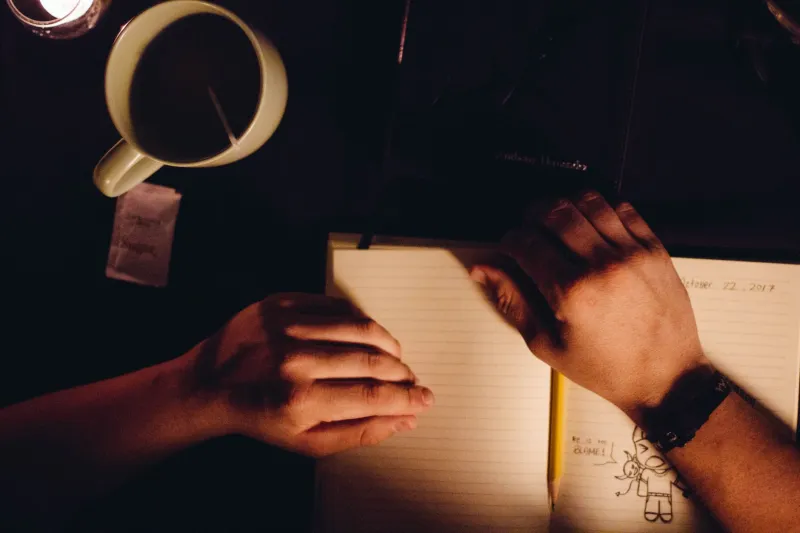
Jay P talks about keeping a kind of running archive — voice memos, journal entries, quick sketches — during the hard times, without the pressure of turning any of it into a finished thing. Just capture. Document. Let it sit. Then, when the dust settles, go back through and see what's there.
You'd be surprised how often the scribble you made at 2 a.m. in the middle of something falling apart becomes the seed of something you're genuinely proud of six months later.
Boredom Is Underrated
Not every creative wellspring is dramatic. Sometimes the raw material isn't a breakup or a health scare — it's just the slow, gray weight of an ordinary week. The commute. The routine. The feeling that life is happening somewhere else.
Boredom gets a bad reputation in creative circles. But boredom is actually a signal that your brain is looking for something. It's restlessness with nowhere to go. And restlessness, when you point it at a canvas or a track or a page, can be incredibly generative.
Some of Jay P's most interesting work has come out of those in-between stretches — not the dramatic highs or lows, but the flat middles. The art that comes from boredom tends to have a specific kind of energy to it: searching, slightly strange, willing to go sideways because there's no obvious direction to go in.
If you're bored right now, that's not a creative problem. That's creative potential without a container yet.
Turning It Into Something
So how do you actually do this? A few things that work:
Start ugly. Don't try to make something polished from raw, messy experience. Let the first draft be a mess. Let the first sketch be rough. The goal at the start is just to get the feeling out of your body and onto something external where you can look at it.
Change the frame. Sometimes the direct approach — writing literally about what happened — doesn't work. Try a different angle. A character who's going through something parallel. A visual metaphor. A beat that sounds like the feeling without naming it. Distance can be a creative tool.
Ask what it's actually about. A breakup song might not really be about the relationship. It might be about fear of abandonment, or the loss of a version of yourself, or the way time moves. Dig past the surface event to the deeper thing underneath. That's usually where the real material lives.
Give yourself permission to be uncomfortable. The most authentic work tends to come from the places we're most reluctant to go. If something feels too personal, too raw, too embarrassing to share — that's often a sign you're onto something real.
The Alchemy Is the Point
Jay P's whole creative philosophy circles back to this idea: nothing is wasted. The weird job you hated. The relationship that wrecked you. The year everything felt stuck. The Tuesday that felt like it lasted a month.
All of it is material. All of it has frequency. All of it, handled with enough intention and craft, can become something that makes someone else feel a little less alone in their own version of the same experience.
That's the alchemy. Not turning pain into profit or trauma into content — but turning lived experience into genuine connection. That's what the best art does. And the raw ingredients are already sitting there, right inside the hardest parts of your life, waiting to be made into something.
You just have to be willing to go back in and get them.