Pencil Lines to Gallery Walls: The Artistic Journey of Jay P
Let's be honest about something: most people who discover Jay P come through the music first. A playlist recommendation, a feature on someone else's track, a song in a short-form video that makes you stop scrolling and actually look up who made it. The music is the front door. But for a lot of longtime fans, the visual work is what makes them stick around — and it's what's increasingly putting Jay P in conversations that go well beyond the music world.
The visual art practice didn't start with gallery shows or commissions. It started the way most creative things start: privately, experimentally, and without any particular goal in mind.
The Sketchbook Years
Go back far enough and you find a pretty familiar origin story. Sketchbooks filled with figure drawings, abstract shapes, attempts at portraiture, a lot of crossed-out experiments. Jay P has been open about the fact that drawing was always happening alongside the music — not as a separate pursuit but as part of the same restless creative energy that needed somewhere to go.
What's interesting, looking at early work that's occasionally surfaced in interviews or social posts, is how directly the visual aesthetic connects to the sonic one. The same interest in texture, in layering, in building something complex out of simple components — it shows up in both. Early sketches had a kind of collage quality: fragments of imagery arranged in ways that felt more like they were in conversation with each other than composing a traditional scene.
That instinct toward collage would eventually become one of the most recognizable elements of the mature visual work. But in the beginning, it was just a way of making sense of things on paper.
Taking the First Public Risk
The shift from private practice to public work is a significant moment for any artist, and it's rarely as dramatic as it sounds in retrospect. For Jay P, it started small — sharing work on social media before that felt as calculated as it does now, letting visuals accompany music releases without making a big deal about the fact that both were coming from the same place.
The reception was cautious at first, which is pretty normal. Audiences who follow someone for music don't automatically extend that trust to visual work. There's a kind of skepticism — is this actually good, or does it just benefit from the association? Jay P's answer to that unspoken question was to keep making work and let it develop its own identity over time.
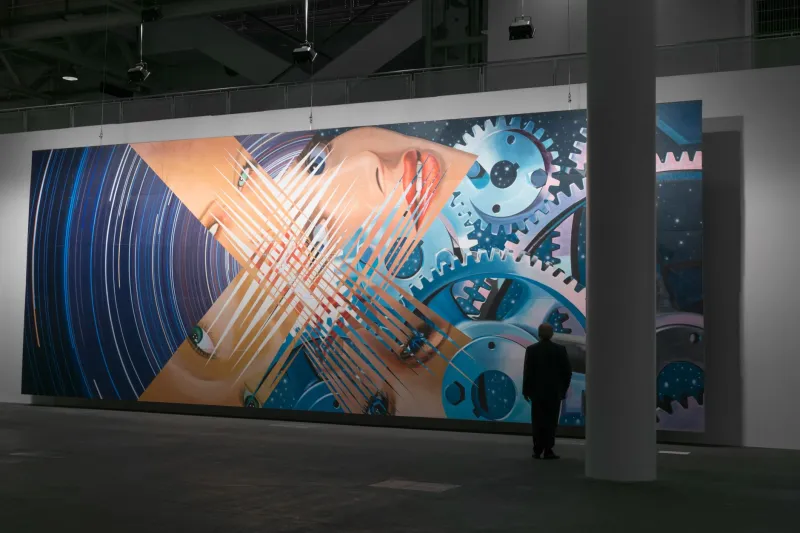
The first real public installation — a mixed-media piece shown at a small gallery in Los Angeles — was a turning point. It combined printed imagery, hand-drawn elements, and audio components that played in the space. It wasn't a massive show. But it established something important: the visual work wasn't a side project. It was a full practice.
Where Music and Visual Art Actually Meet
One of the things that makes Jay P's artistic output genuinely distinctive is that the music and visual work aren't just made by the same person — they actually inform each other in ways you can trace if you pay attention.
Album art isn't outsourced; it's made by Jay P and treated as part of the same creative statement as the music itself. Visual themes from a particular period of work tend to reflect what's happening sonically — denser, more layered imagery during periods of more complex production; starker, more minimal visuals when the music strips back.
This kind of integration is increasingly rare. The music industry's default is to separate these functions, to treat visual identity as a branding exercise managed by someone else. Jay P's approach — keeping it all in-house, keeping it all connected — is a deliberate choice that comes with real trade-offs. It takes more time. It requires more creative bandwidth. But the coherence it produces is something fans respond to, even if they can't always articulate why.
The Sold-Out Moment and What It Actually Means
When a recent installation sold out its limited-edition print run within hours and drew a waitlist for the physical show, there was understandably some buzz about it. And that success is real — it represents years of consistent work paying off in a concrete, visible way.
But it's worth being clear-eyed about what that moment represents and what it doesn't. It doesn't mean the work suddenly got better. It means the audience caught up to where the work already was. That's a distinction that matters, especially for emerging artists who are tempted to chase external validation as a signal that they're on the right track.
The work that sold out wasn't made to sell out. It was made as part of an ongoing exploration that's been happening for years. The commercial moment is a byproduct of creative consistency, not the goal.
What This Means for Artists Building a Multi-Disciplinary Practice
If you're an artist — visual, musical, or somewhere in between — trying to figure out how to build something sustainable in a landscape that rewards virality over depth, Jay P's trajectory offers a few things worth thinking about.
First: don't apologize for working across disciplines. The pressure to pick a lane and stay in it is real, but it's largely a platform-driven pressure, not an artistic one. The most interesting creative work has always happened at intersections.
Second: let the private practice stay private long enough to develop. Not everything needs to be content. Sketchbooks exist for a reason. Give your experiments room to fail before they're subjected to public response.
Third: integration is a long game. The coherence between Jay P's music and visual work didn't happen overnight — it developed through years of both practices existing simultaneously and gradually finding a shared language. That kind of depth can't be manufactured quickly, but it's also the thing that's hardest to replicate.
The gallery walls came after a lot of bedroom sketches. That sequence matters.