Mud Season: What Nobody Tells You About the Space Between the Spark and the Finished Thing
There's a version of creative work that looks really good on camera. The late-night studio session with the right lighting. The sketchbook open to a page that's already halfway brilliant. The moment you hold up a finished canvas and the colors just hit. That version is real — but it's about ten percent of the actual job.
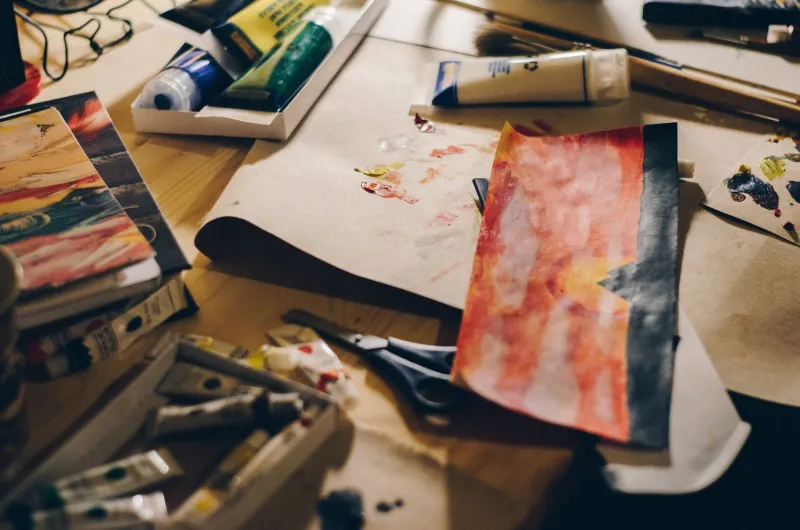
The other ninety? It's a mess. It's crossed-out lines and deleted voice memos and color palettes that looked perfect in your head and turned into something that resembles a parking lot at 2 a.m. It's the phase nobody talks about because it doesn't photograph well. Call it the mud season. The ugly middle. The part of the process where you're pretty convinced you've lost whatever made you good at this in the first place.
Here at Jay P, we've been sitting with that phase a lot lately — and honestly? We think it deserves more credit than it gets.
The Myth of the Clean Creative Process
Social media has done something weird to how people understand art. When every finished piece gets documented and shared, the natural assumption is that the path from idea to output is relatively smooth. You get inspired, you execute, you post. Rinse and repeat.
But that's not how it actually works for almost anyone making real stuff. Ask any musician about the songs that didn't make the album — the ones that got halfway built and then gutted, repurposed, or just quietly abandoned. Ask a visual artist how many sketches live in a drawer that nobody will ever see. The finished work that connects with people is almost always sitting on top of a pile of failed attempts that were necessary to get there.
The problem is that when artists only share the polished output, everyone else — including other artists — starts to believe that the struggle is a sign something's wrong. It's not. The struggle is the process.
Why the Awkward Phase Is Actually Doing the Work
Here's the thing about the ugly middle: it's where the real decisions get made.
When a piece is still rough, you're forced to engage with it honestly. You can't hide behind production value or a clean finish. You have to ask whether the idea itself is strong enough to carry the weight. That's uncomfortable, but it's also clarifying in a way that nothing else really is.
Think about a rough demo versus a fully produced track. The demo strips everything down. If the melody isn't there, you hear it immediately. If the lyric is doing too much or not enough, it's obvious. Some of the most important creative work happens in that stripped-down space — not because it sounds great, but because it's honest about what's working and what isn't.
Same goes for visual work. A pencil sketch forces you to commit to line and form without the safety net of color or texture. If the composition is off, you know early. If you'd jumped straight to the final piece, you might not catch it until you've already put in twenty hours.
The mud season is basically a built-in quality filter. It's just not a comfortable one.
The Danger of Sharing Too Soon
There's a specific kind of creative trap that's become more common in the age of constant content: sharing work before it's had time to develop its own identity.
The feedback loop of likes and comments can feel like validation, but it can also freeze a piece in an early state. When something gets a reaction — even a good one — it's tempting to lean into whatever got that response rather than letting the work go wherever it actually needs to go. You start making decisions based on what landed instead of what's true to the piece.
That's not always bad. Audience feedback matters. But there's a difference between sharing a finished thing and sharing a developing thing, and the timing matters more than people realize. Work that's still finding itself needs room to be wrong without consequence. It needs the space to try something that doesn't work and then try something else.
Keeping the ugly middle private — at least for a while — protects that space. It lets the work be bad on its way to being good, which is the only real path there is.
What Leaning Into the Mess Actually Looks Like
This isn't about perfectionism, and it's definitely not about hiding forever. The goal isn't to never share anything until it's flawless — that's its own kind of trap. It's more about changing your relationship to the in-between phase so you stop treating it like a problem to be solved as fast as possible.
A few things that actually help:
Give the rough draft a deadline, not a launch date. Instead of thinking about when you'll share something, think about when you'll decide whether it's worth finishing. That takes the pressure off the early phase and lets you evaluate more honestly.
Keep a separate space for the ugly stuff. Whether that's a physical sketchbook, a private folder, or a voice memo app — having somewhere that's genuinely just for you changes how freely you work. Nothing in that space needs to be good. It just needs to exist.
Stop treating revision as failure. In American culture especially, there's this mythology around the first draft, the raw take, the unfiltered thing. And sometimes that energy is real. But revision isn't a sign you got it wrong the first time. It's a sign you care enough to get it right.
Let it be ugly out loud — just not publicly. Talk to people you trust about the messy middle. Not for feedback necessarily, but just to normalize the fact that it exists. When artists start being honest with each other about how nonlinear the process actually is, it takes some of the weight off.
The Work Nobody Sees Is Still the Work
Here's what it comes down to: the hours spent in the ugly middle aren't wasted time. They're not a detour from the real work. They are the real work, just in a form that doesn't make for a great post.
The sketches that never left the notebook shaped the ones that did. The takes that got deleted trained your ear for what the right take sounds like. The rough drafts that went nowhere taught you something about where the idea actually wanted to go.
Audiences connect with finished work, but what they're actually responding to is everything that went into it — including the stuff they never saw. You can feel the difference between a piece that was rushed to polish and one that was allowed to find its form. It's hard to describe, but it's real.
So if you're in the mud right now — if the thing you're making looks nothing like what you imagined and you're not sure whether to push through or start over — that's not a sign you've lost it. That's just mud season. Everybody goes through it. The ones who come out the other side with something real are usually the ones who stopped trying to skip it.
Keep going. Nobody's watching. That's kind of the whole point.